limpid

Synthetic personas. Traceable qual. From brief to deliverable.

More than synthetic personas: a research protocol. Limpid runs complete qualitative studies with synthetic respondents. Rare, costly or hard-to-recruit audiences become reachable, and ready-to-share deliverables arrive within hours.

Six clients can try Limpid before it opens. They use it on their own studies, supported directly by the founder. To apply, request a call.

The rigour of a study

A protocol at every step: scoping, a calibrated population, interviews conducted, analysis challenged. And Limpid tells you when the method is not right for your need.

Everything is traceable

You know how the population was built, and from which sources. Every finding traces back to the interviews behind it.

Actionable deliverables

Decisions ranked by priority, hypotheses to test, a report and presentation fit for a board meeting, and a study you can keep questioning.

Why Limpid

The difference between asking an AI for its opinion and running a study.

I spent thirty years running market research agencies. Today I see a temptation taking hold: settling important marketing questions, sometimes societal ones, by asking a chatbot for its opinion. It’s fast, it’s free, and it’s a trap.

On its own, a model gives you a smooth average: no method, no pushback, and no way of knowing who thinks what, or why.

I didn’t create Limpid to reject this kind of approach, but to give it what it lacks: the rigour of a study. Personas built and checked to represent a target rigorously. A method at every step. Safeguards throughout the process.

Patrick van Bloeme, founder of Limpid

Where does Limpid fit?

Before other studies, after them, and wherever fieldwork is difficult or impossible.

01

Before other studies

  • Scoping a topic before launching a major study: finding the dimensions that matter, the issues worth digging into, the words people actually use.
  • Designing a discussion guide or a questionnaire, and testing it before fieldwork: asking the right questions from the very first interview, and spotting the ones that teach you nothing.
  • Screening concepts or messages, and only taking the strongest into the field.
  • Deciding which segments are worth interviewing, before committing to fieldwork.
02

After other studies

  • Bringing an existing segmentation to life: static descriptions become personas you can interview without limit.
  • Deepening or extending an existing study: new questions, new targets, new geographies.
  • Testing what you plan to do with it: courses of action, or variations of concepts and messages already tested.
  • Measuring the impact of an event on a topic studied before it: the same profiles, the same questions, after the fact.
03

Where fieldwork is difficult or impossible

  • Interviewing hard-to-recruit targets: by profile (doctors, executives, teenagers, patients with a rare disease) or by territory (catchment area, small town, remote or island communities).
  • Exploring particular life situations: moving house, separation, a new job.
  • Testing fictional or dystopian scenarios: a health crisis, a food scandal, a radicalised social movement.
  • Addressing sensitive topics: health, sexuality, religion, bereavement, illicit or illegal practices.
  • Working on confidential topics: pre-launch, embargoed products, strategic plans.

And when the timeline leaves no room for fieldwork, or when the question does not justify a major study.

If you are wondering when and how to use this kind of approach, just ask us.

Tell us about your case

The Limpid protocol

Five safeguards, in every study.

Every method has its own biases. A poorly sampled survey produces questionable figures; a poorly recruited or poorly moderated focus group misleads. Quality never comes from the tool alone, but from the framework around it. Here is what Limpid’s framework guarantees.

Your audience, calibrated down to the sociology

If your target calls for 35% of 70–74-year-olds, the set of personas contains 35%: proportions are calculated, not left to the model. And demographics are not enough: living environment, relationship to values, way of thinking and everyday quirks are calibrated too.

Figures are never made up

The data used to build your target is sourced and shown. Limpid selects its sources, and when one is missing or cannot be substantiated, Limpid says so and suggests how to find it. Limpid can also include your own sources.

The right not to know

A persona can hesitate, say it does not know, or disagree. People-pleasing and omniscience are model flaws, and Limpid fights them instead of putting up with them.

No finding without evidence

Every finding is anchored in a verbatim. And before it reaches you, the analysis is challenged: does it bring anything new, and is the diversity of the corpus properly represented?

Model biases, corrected

Left to itself, a model produces personas that are too smooth: too educated, too urban, all equally at ease explaining how they feel, and ending up sounding alike down to their turns of phrase. These drifts are measured and corrected: finalising the personas means refusing to inherit the biases of language models, and correcting implicit stereotypes, voices that are too similar, and profiles all clustered in the same place.

Your studies are hosted in France, on secure servers, with encrypted storage.

Being upfront

What Limpid does not do.

Limpid is an exploration layer, not a substitute for being in the field. In some areas, it prepares and guides the work without replacing it.

Projectable figures

Limpid produces in-depth qualitative insight, not percentages representative of a population. To size a market or measure awareness, sample-based quantitative research remains essential. Limpid sheds light on the why, not the how many.

Sensory experience

What is tasted, smelled, touched or worn escapes the persona. It can reason about the concept of a coffee or a perfume, without being able to taste it. Product testing remains fieldwork, which Limpid prepares and guides.

Being there

The experience of a specific shop, a physical journey on a busy day, the emotion of a moment on the spot: Limpid models credible behaviours, without capturing what it is like to actually be there.

And Limpid does not leave you to find this out alone: it flags when a topic calls for fieldwork, rather than steering you towards an unsuitable study.

The foundations

This isn’t science fiction: it rests on an established body of research.

Published research shows that language models, fed with detailed profiles, can reproduce a substantial share of human answers and behaviours.

Park et al., 2024 · Stanford University
Generative Agent Simulations of 1,000 People

Calibrated on real people, agents reproduce their answers to a major sociological survey almost as faithfully as those people reproduce their own.

Park et al., 2023 · Stanford University
Generative Agents: Interactive Simulacra of Human Behavior

Starting from a biography, they produce behaviours that human evaluators judge credible.

Argyle et al., 2023 · Brigham Young University
Out of One, Many: Using Language Models to Simulate Human Samples

Synthetic samples reflect the actual links between ideas, attitudes and social background in a population, beyond mere surface resemblance.

Who is behind it

More than thirty years of experience, condensed into one platform.

Patrick van Bloeme
Founder of Limpid
30 years leading market research agencies

He pioneered online research more than twenty-five years ago, as fieldwork moved from the telephone to the web, and has spent recent years pioneering AI in insights.

Limpid condenses thirty years of research practice, applied to what synthetic respondents make possible.

His aim in founding Limpid: to bring together in a single platform all the research and AI skills that, combined, produce research that can shape decisions.

What you receive

A study is only as good as what you can do with it.

Rigour shows in substance as much as in form: a method held at every step, and documents crafted down to the layout.

Here is a preview of what a single study produces, testing the concept of free weekend bus travel in England: 74 interviews, six mobility profiles drawn from a published segmentation, one brief to start with.

The deliverables below are shown in French. Limpid works in English, French, Spanish, German and Italian.

Limpid can interview personas from almost any country in the world.

Swipe to see the other visuals. Tap an image to open it full size.
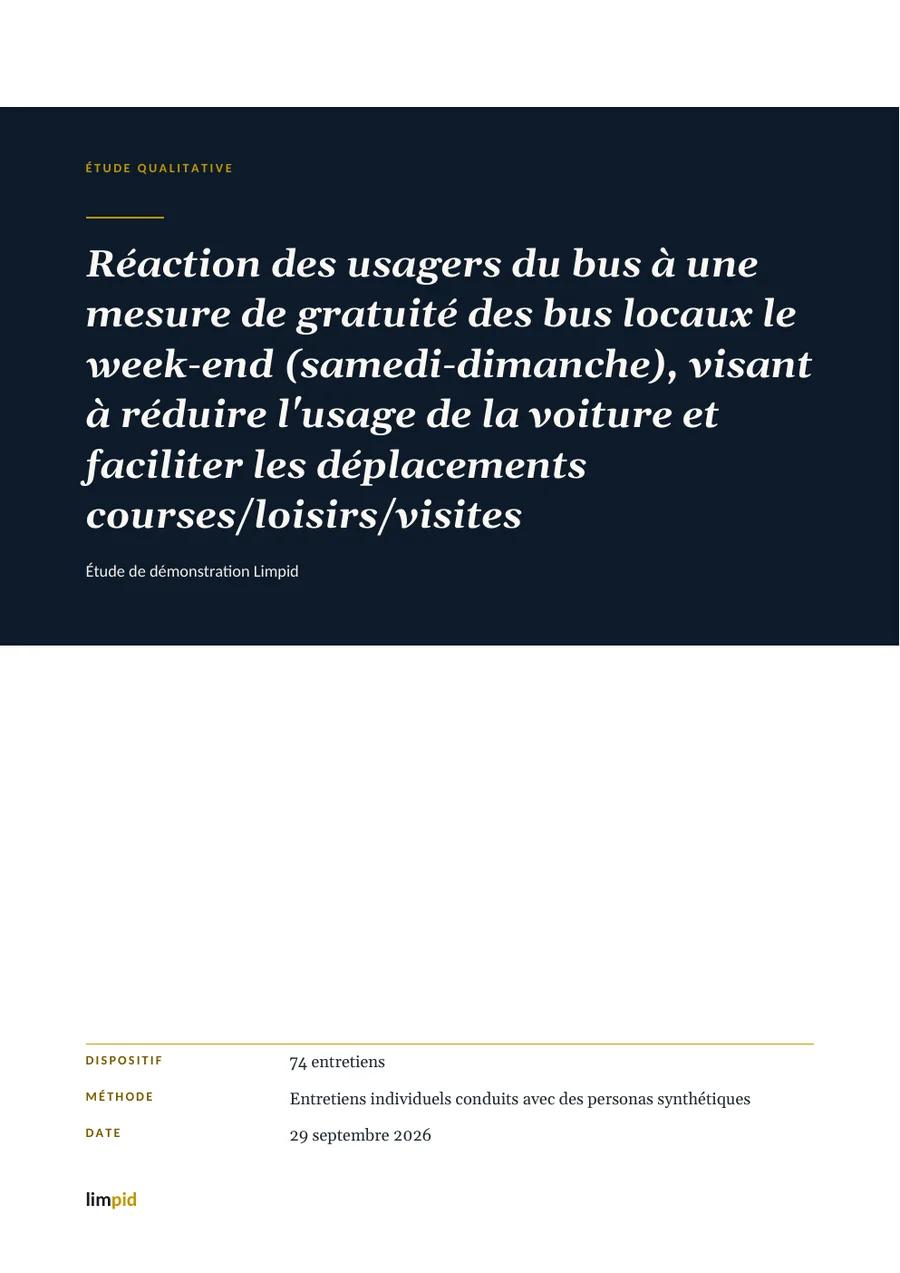
Report cover: study title, set-up of 74 interviews, method and date (in French)
The cover: set-up, method and date, stated plainly.
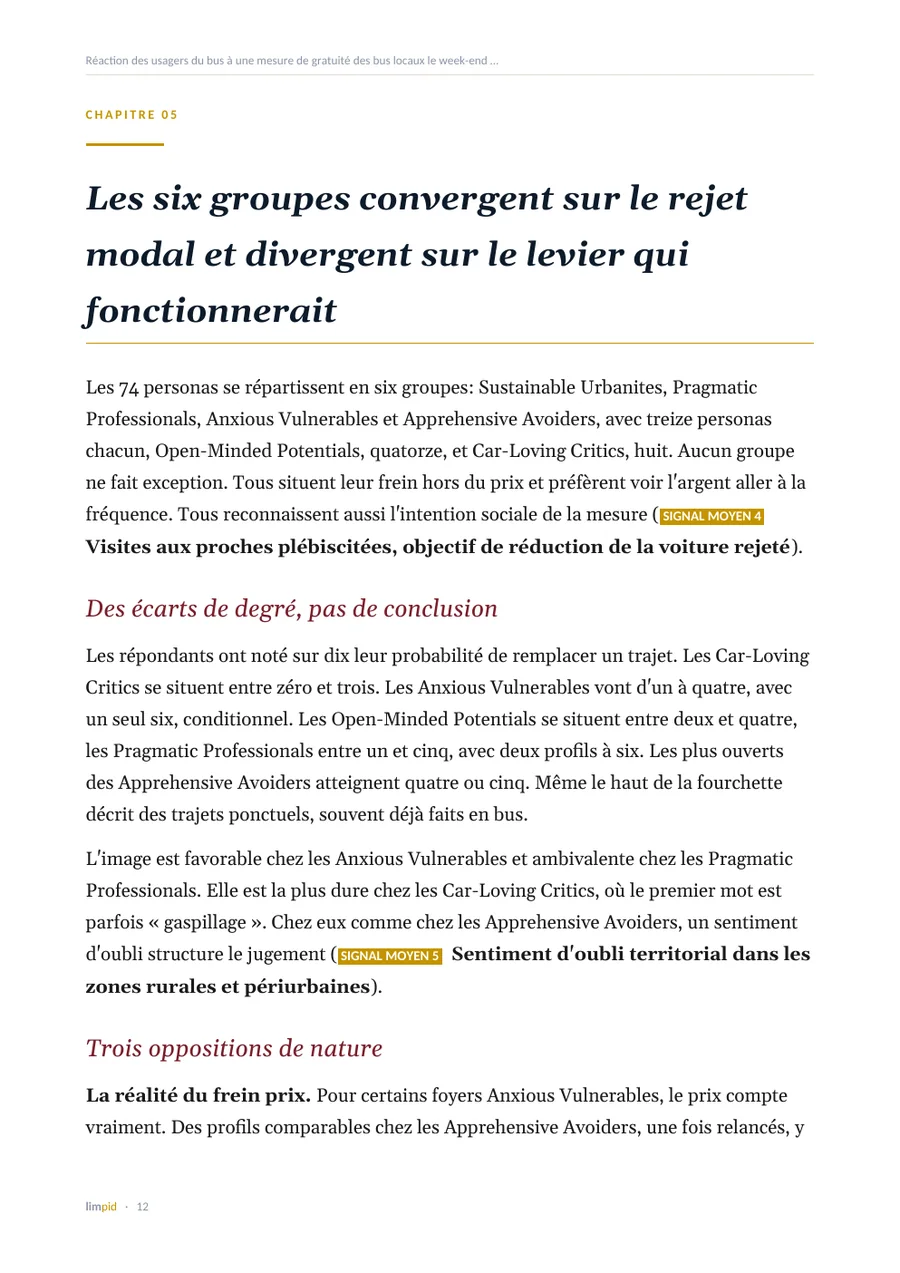
Report page comparing the six groups: what they share, differences of degree, oppositions of nature (in French)
The six groups compared: differences of degree and differences in kind, each finding rated by the strength of the evidence behind it.
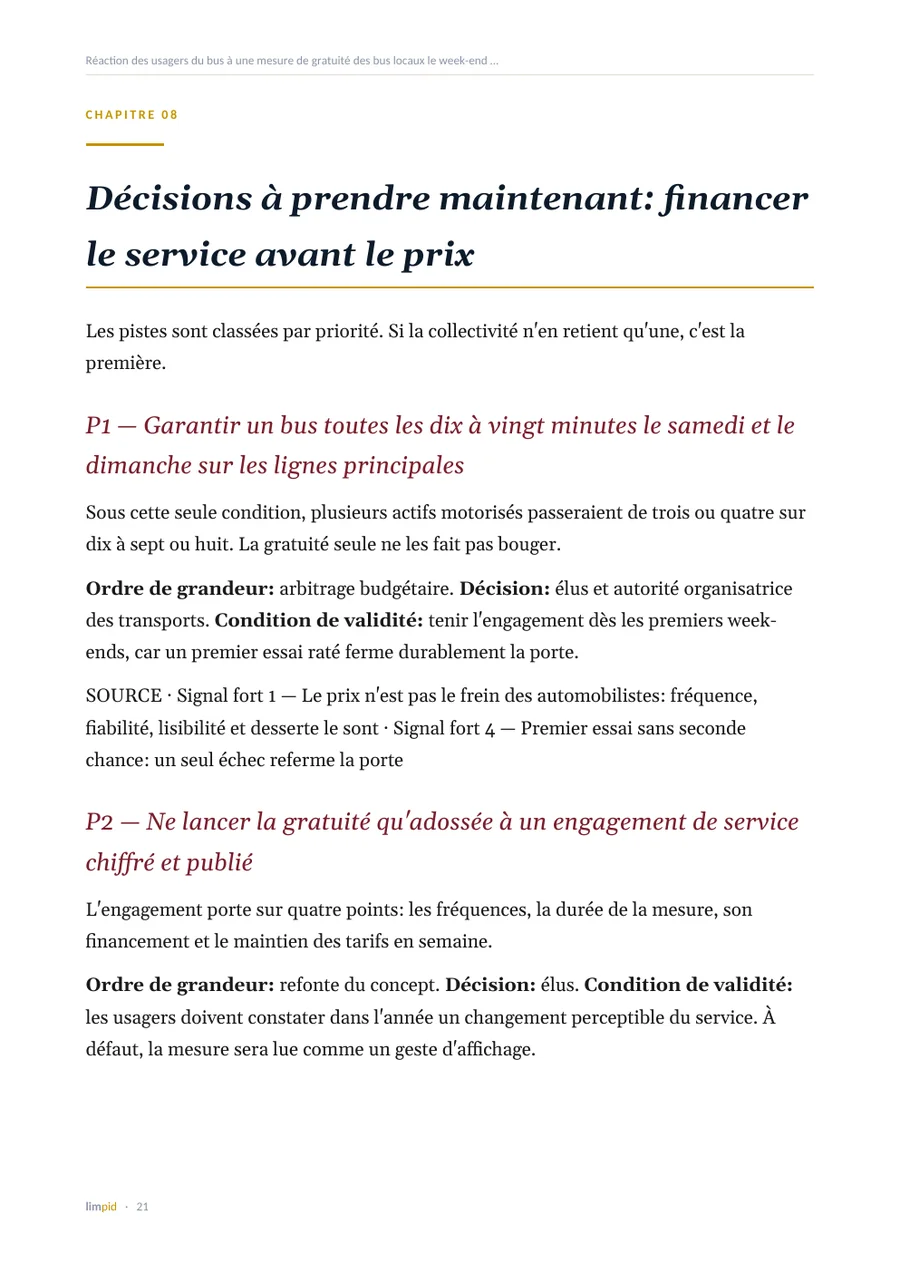
Report page ranking decisions by priority, with their condition of validity and the signal behind them (in French)
Decisions ranked by priority, each with its condition of validity and its source.

Every tension identified, what it says, what can be done with it. And every conclusion anchored in verbatims, from the executive summary to the methodological appendix.
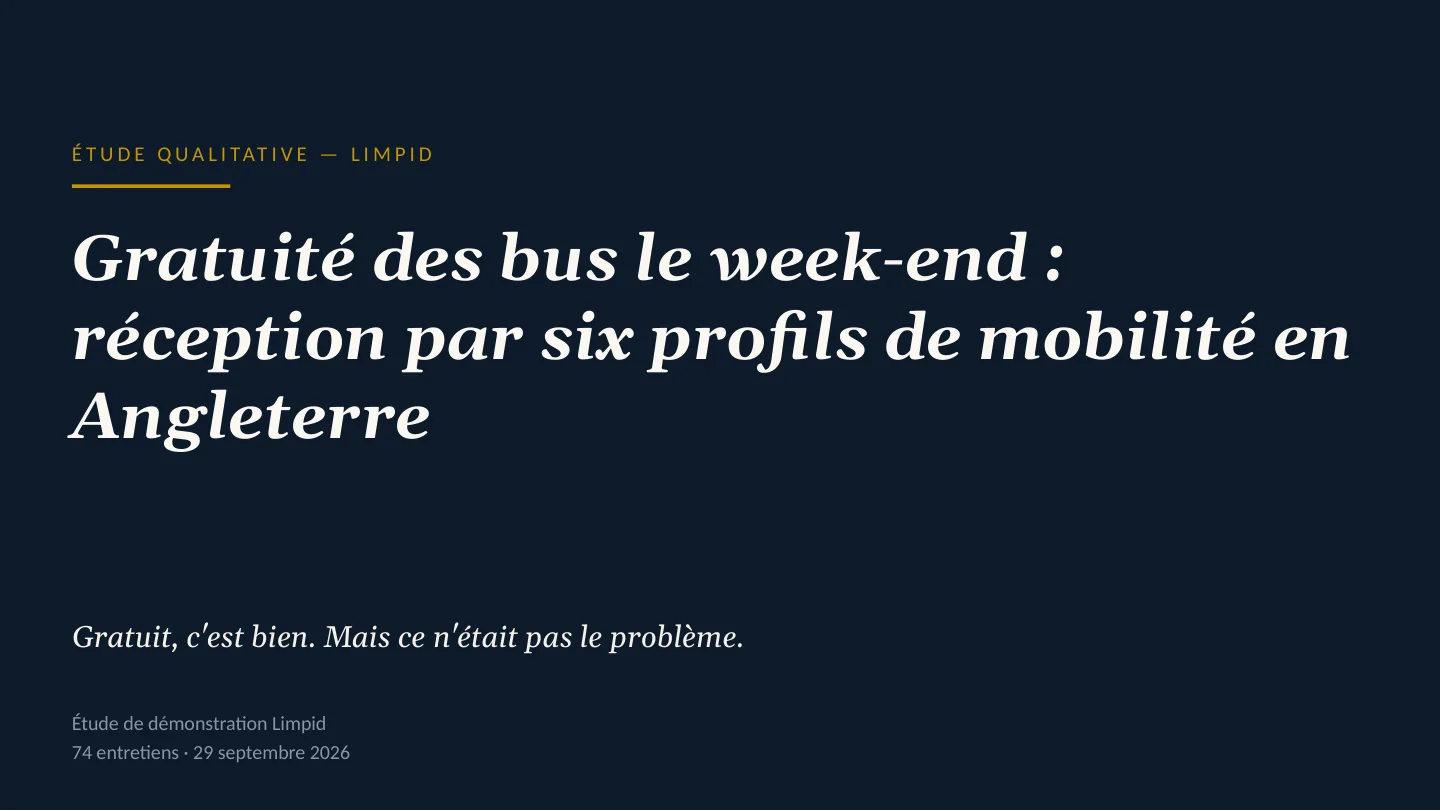
Presentation cover: free weekend buses, as received by six mobility profiles in England (in French)
A cover that states the conclusion.
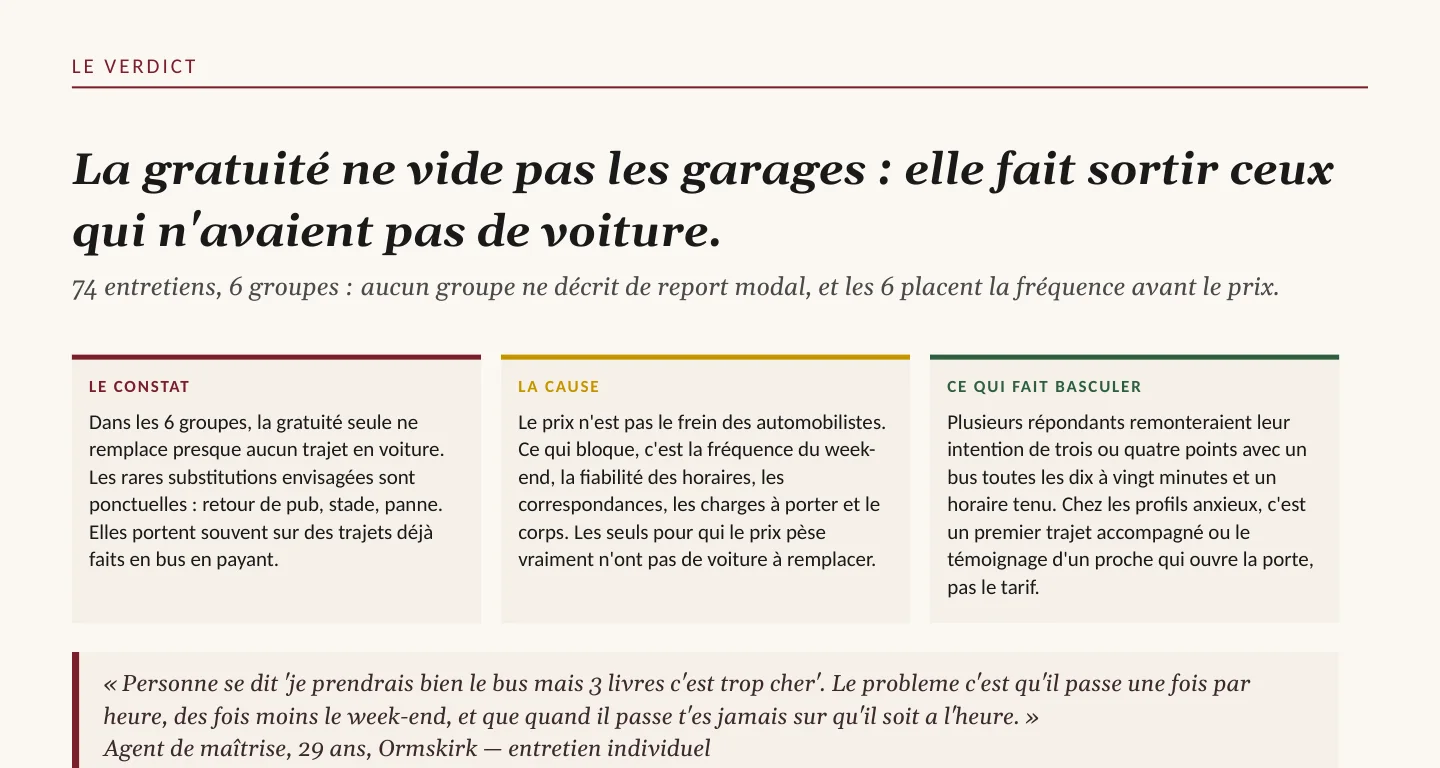
Verdict slide: free buses do not empty garages, with the finding, the cause, what tips the balance and a verbatim (in French)
The verdict on slide two: the finding, its cause, what would tip the balance.
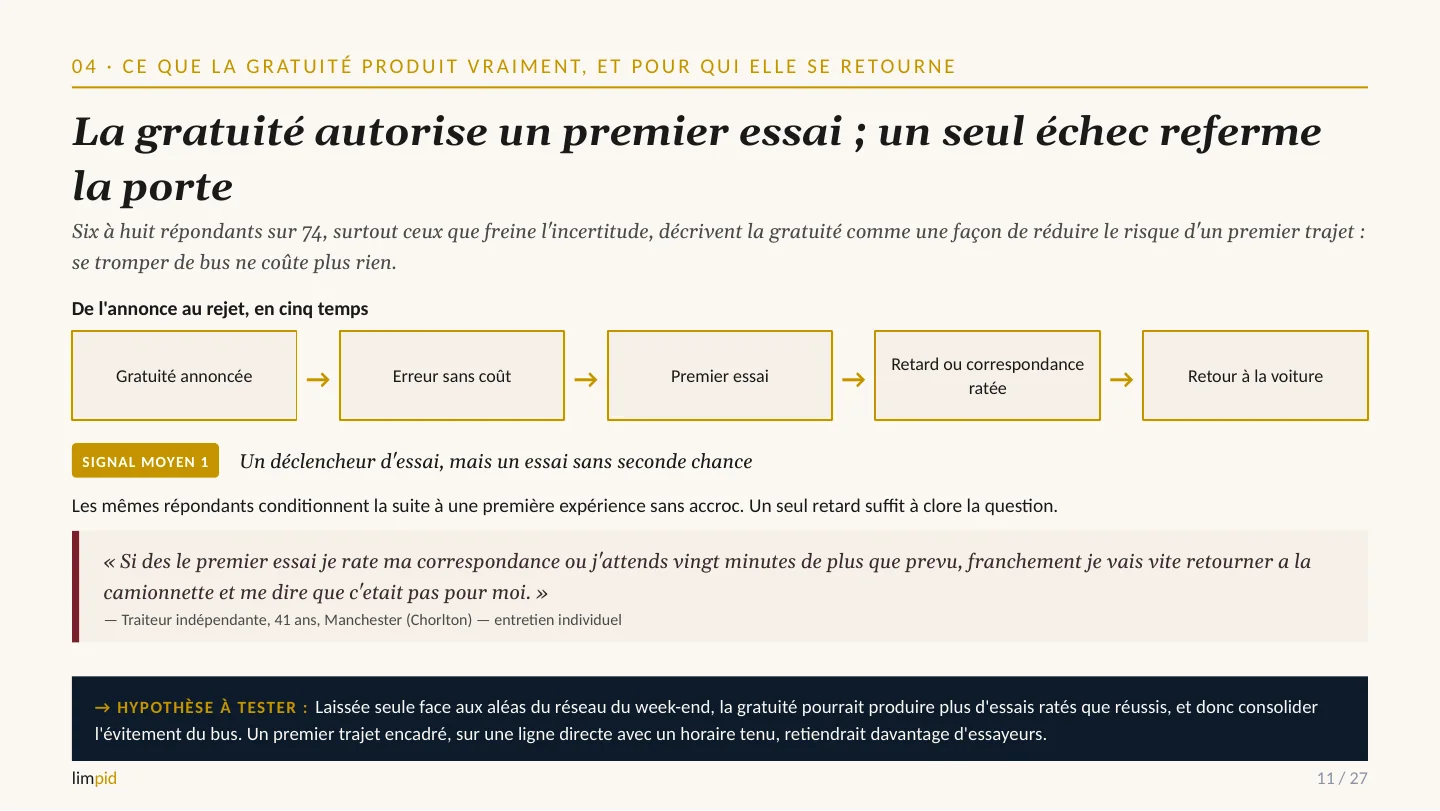
Slide diagramming a five-step mechanism, rated as a medium signal, proven by a verbatim and turned into a hypothesis to test (in French)
A mechanism turned into a diagram, rated for robustness, backed by a verbatim and converted into a hypothesis to test.
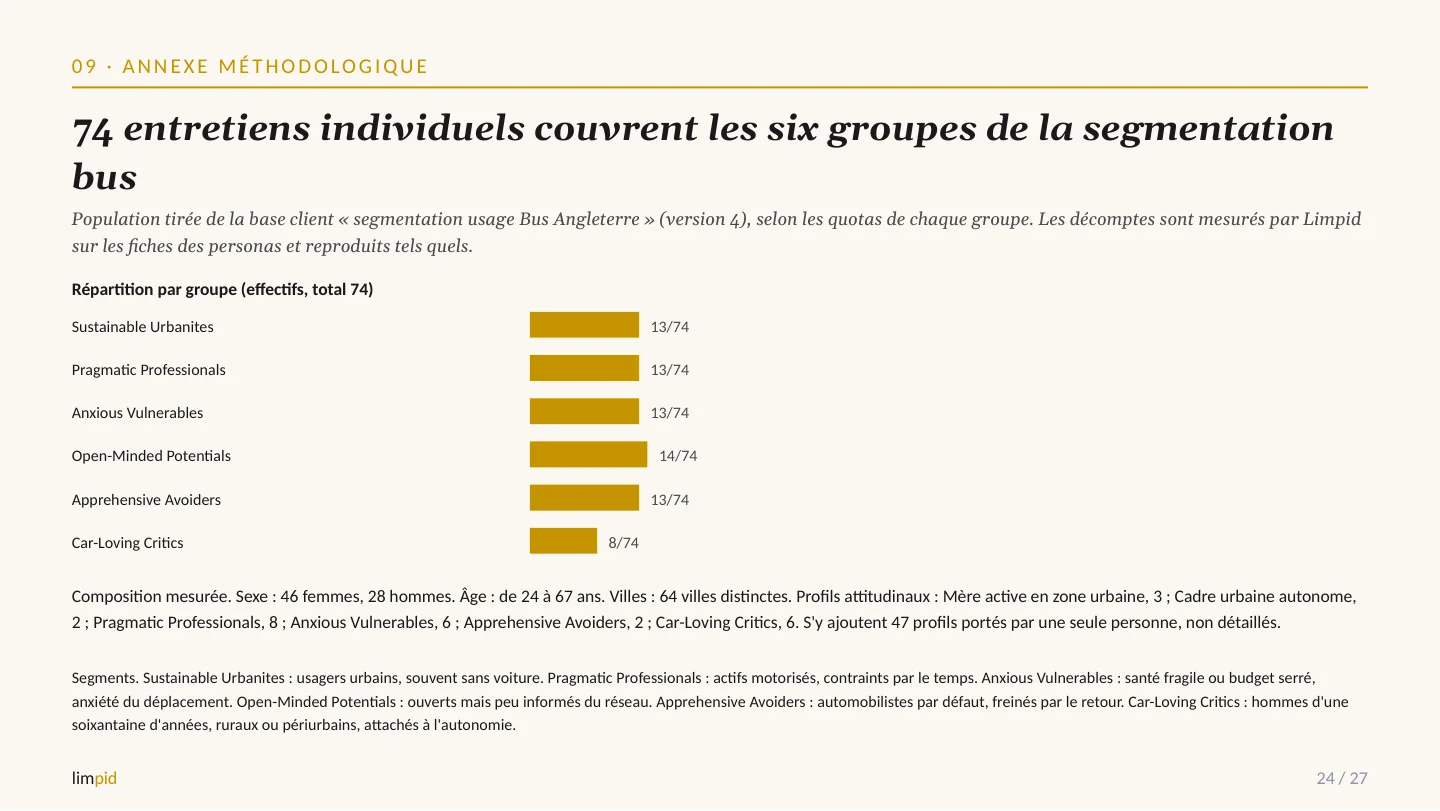
Appendix slide: the 74 interviews split across the six groups, as bars, with the measured composition (in French)
The methodological appendix: who was interviewed, and how many in each group.

Slides built to be presented: a finding, what we infer from it, what we propose to do about it. And a suggested voice-over in the speaker notes.
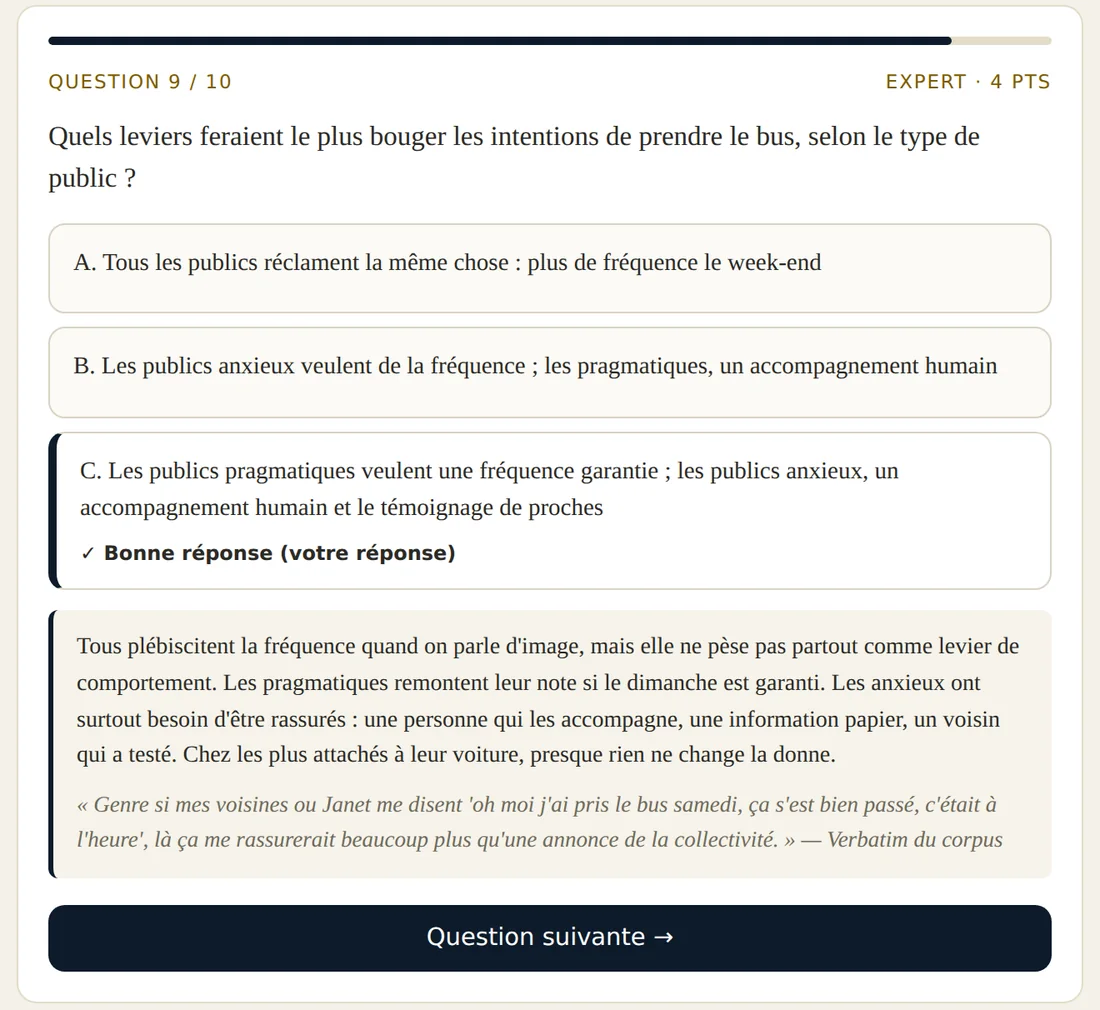
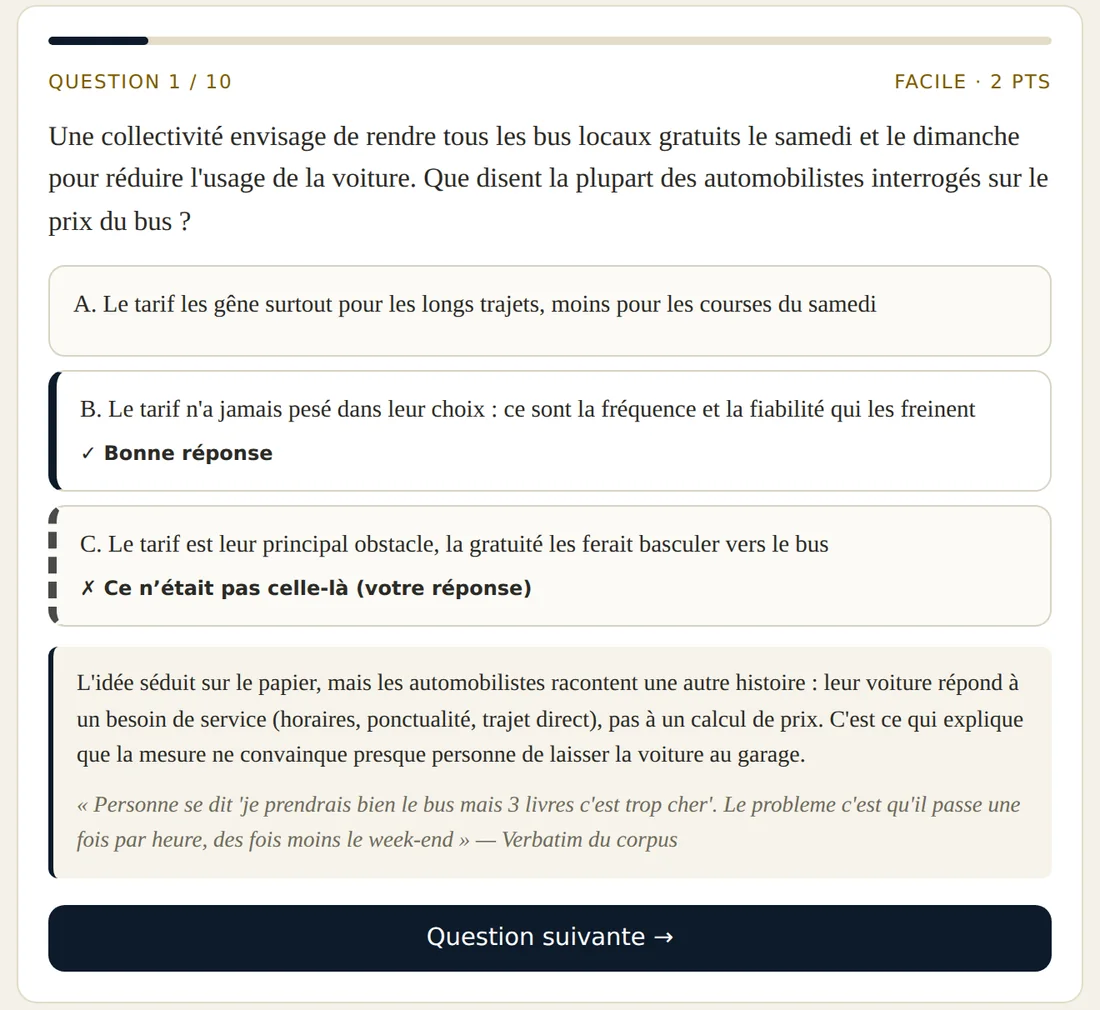
Expert-level question answered correctly: the right answer, what it teaches and the verbatim that proves it (in French)
A right answer: what it teaches, and the sentence from the corpus that proves it.
Question answered wrongly: the chosen answer is marked wrong, and the right answer and explanation are given (in French)
A wrong answer: the right one, and why.
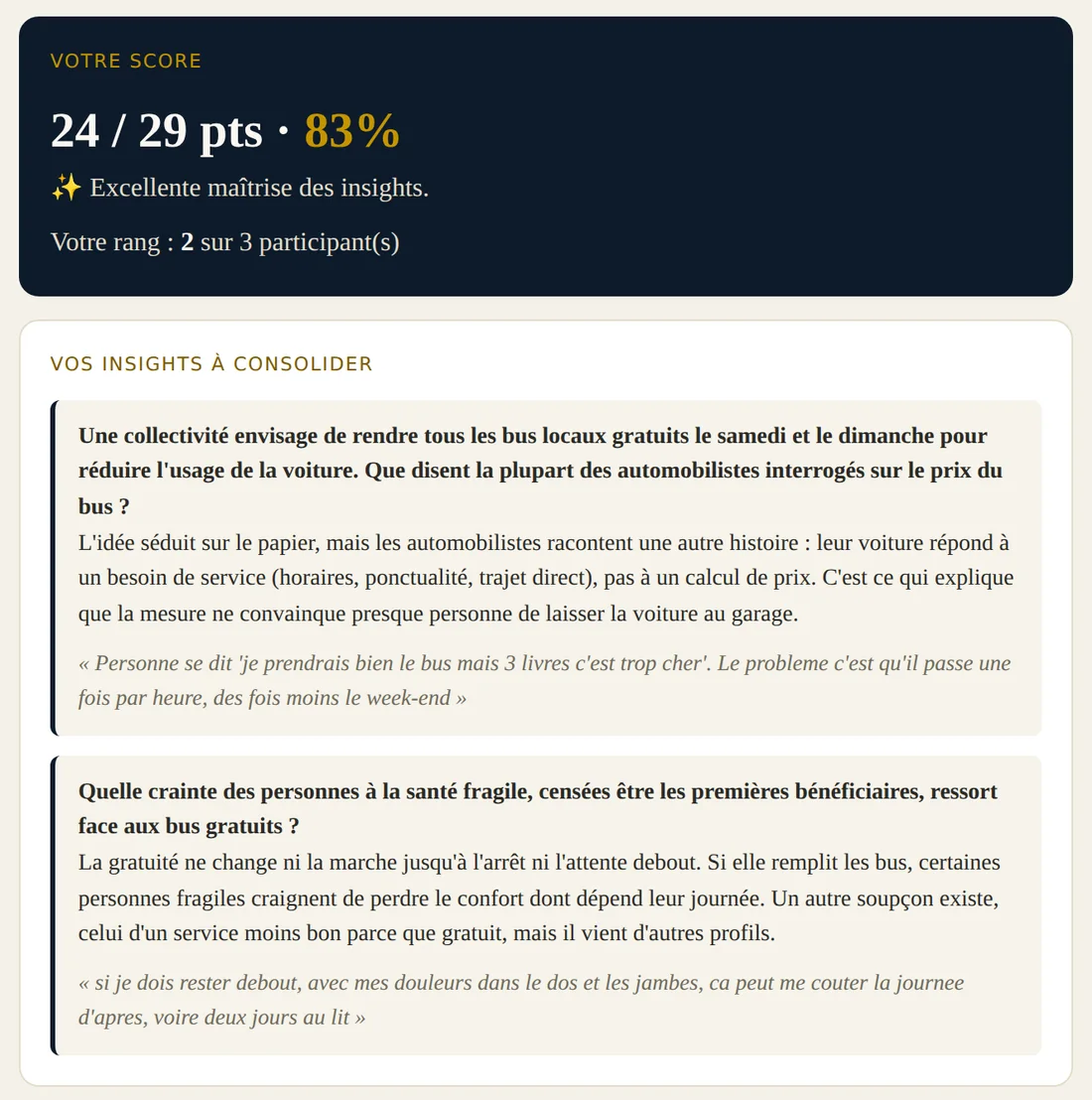
Quiz summary: 24 points out of 29, and the lessons to consolidate, each with its verbatim (in French)
The participant’s summary: their score, then the lessons to consolidate.

A playful way for teams to take ownership of the findings.
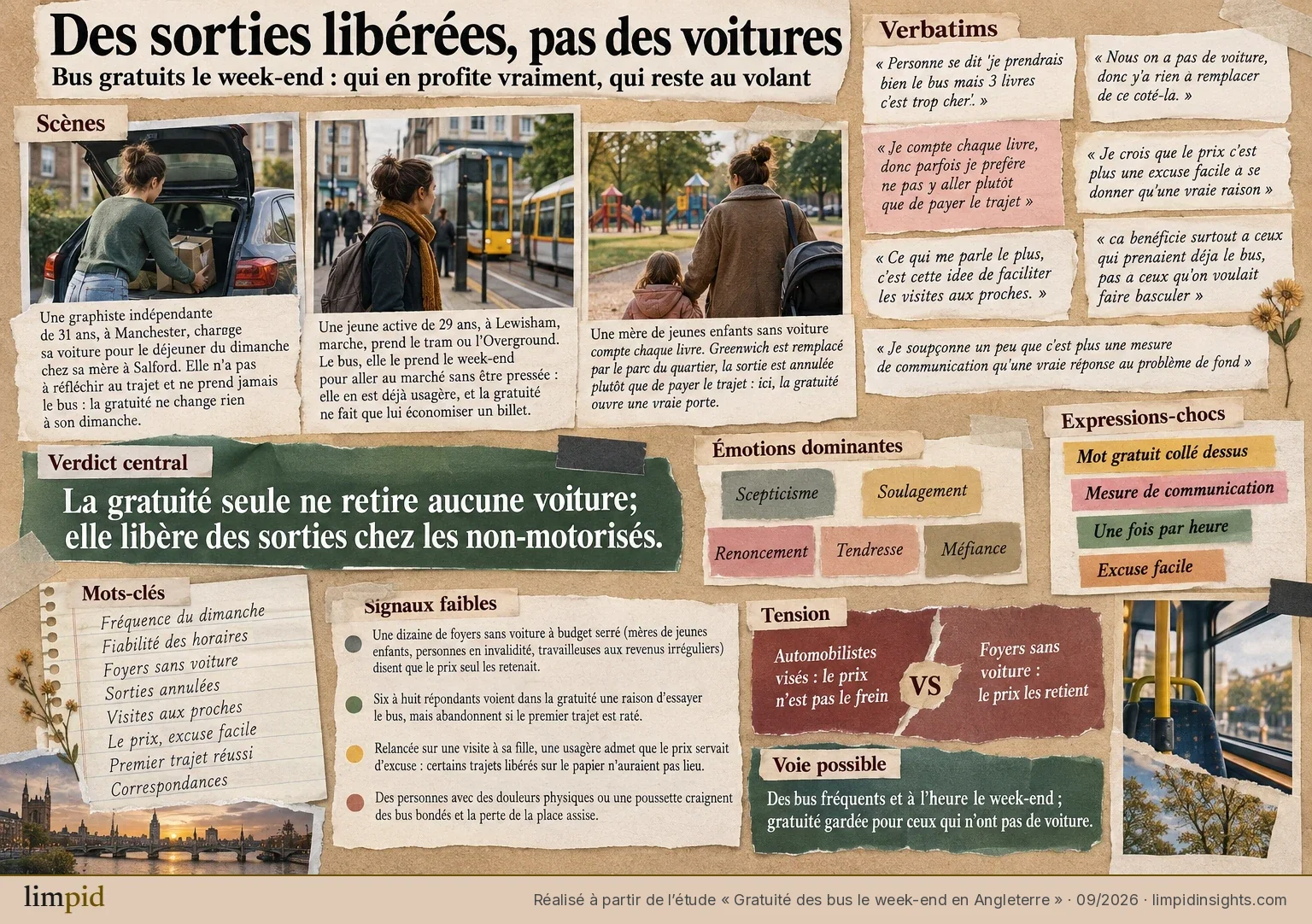
Study moodboard: illustrated scenes, verbatims, central verdict, dominant emotions, striking expressions, tension and a way forward (in French)

The world of the corpus on a single board: what keeps coming back, what is said, what goes unsaid. Something to pin on the wall to keep the study in front of the team.
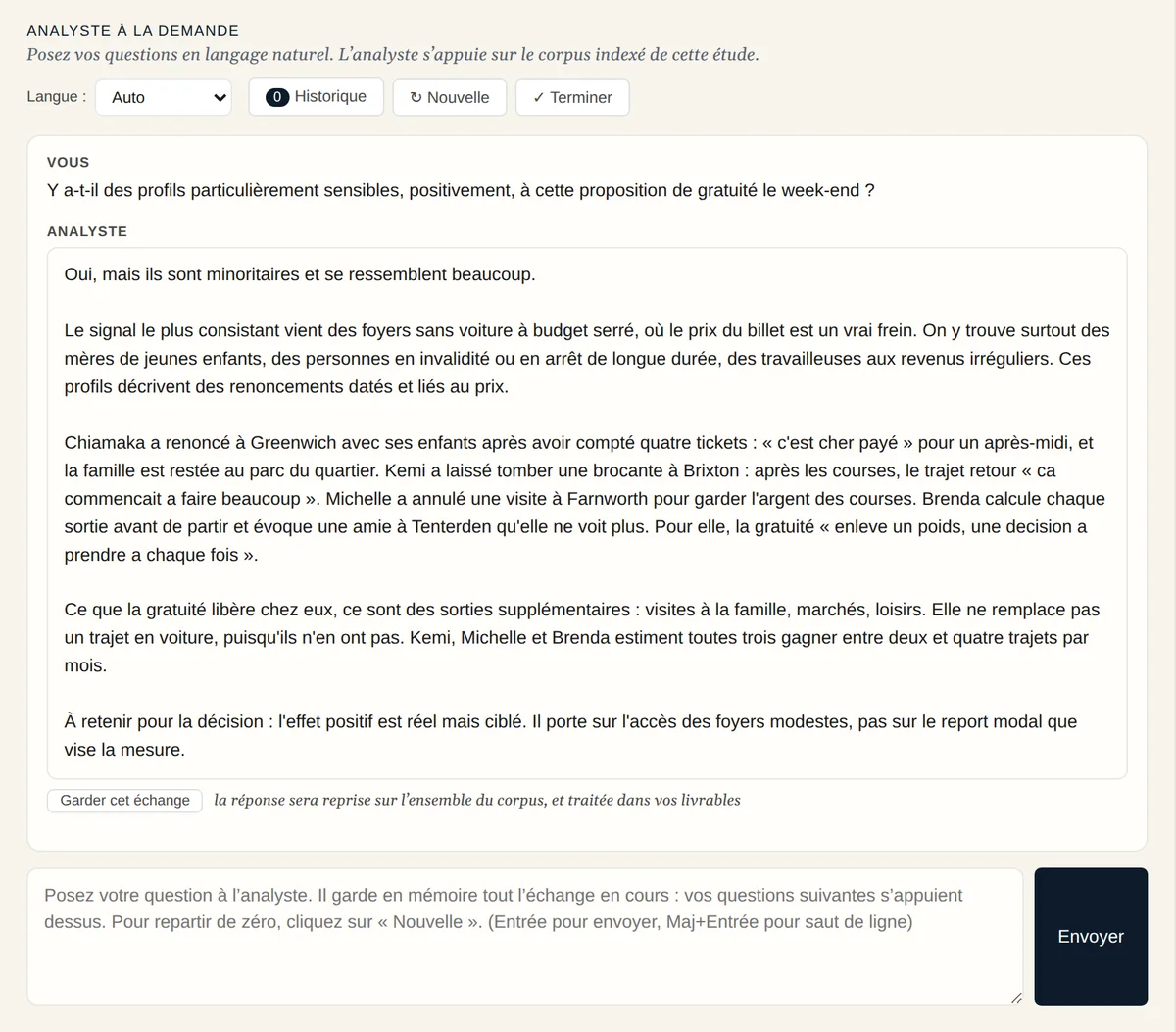
The on-demand analyst: a plain-language question about which profiles respond to free travel, and an answer built from the interviews, with named cases and their verbatims (in French)

And once the report is delivered, you can keep questioning your study in plain language, as often as you need: Limpid answers from the interviews.

Early access

Founder Programme

Six clients, before launch.

Before its launch, Limpid is welcoming its first six clients. Here is what the programme gives them:

  • Access to Limpid before its public launch, with personal support.
  • Training in synthetic research. Method, reading the results, strengths and limits. You come away able to run studies yourself.
  • Your own studies. Your topics, your targets, your deliverables. Not a demo.
  • Founding client status: priority access at launch, and your views on what the platform becomes.
  • A closing group debrief, with the other founding clients.

Only six, because each will be supported by the founder.

This is the only offer available before the platform opens.

Request a call No need to have a topic ready.
Let’s talk

Request a call.

No need to have a topic ready. Just tell us what interests you in the approach, and we will get back to you.

Prefer to write? contact@limpidinsights.com

One sentence is enough; we will go further in conversation.

Your details are used to reply to you and to keep you informed about Limpid’s launch. Nothing else. You can ask for them to be deleted at any time.

limpid Synthetic personas. Traceable qual. From brief to deliverable.